
When the Screen Becomes the Therapist: How AI is Reshaping Our Emotional Landscape
- Apr 20
- 4 min read
It's 2.30 AM. Sarah, a marketing executive, lies awake scrolling through her phone. But she's not checking social media or reading the news. She's typing into an AI chatbot: "I think I'm having a panic attack. My chest feels tight, and I can't stop thinking about tomorrow's meeting."
Within seconds, she receives a response. Calm. Measured. Non-judgmental.
This scene plays out millions of times each night across the world. The digital confessor never sleeps, never judges, and never tells you that you're calling too late.
The New Emotional First Responders
We've crossed an invisible threshold. When emotional storms hit, many now reach for AI before reaching out to friends or family.
A teenager struggling with body image whispers to an AI: "I hate how I look." A new father, overwhelmed and ashamed, admits: "I don't think I'm cut out for this." A retiree facing loneliness types: "Sometimes I go days without talking to anyone."
These aren't edge cases anymore. They're becoming our new normal.
The shift isn't happening because people can't tell the difference between silicon and soul. It's happening because AI offers something uniquely modern: emotional availability without emotional labour.
The Appeal of Digital Empathy
Why are we choosing algorithms over human connection? The answer lies in what AI doesn't do:
It doesn't check its watch while you talk
It doesn't shift the conversation to its own problems
It doesn't remember your vulnerability the next morning
It doesn't get tired of hearing the same fears
For someone drowning in anxiety at midnight, these absences feel like features, not bugs.
AI has become our emotional Switzerland - neutral, available, and infinitely patient. It offers:
Immediate validation when self-doubt peaks
Structured exercises for managing overwhelming feelings
Language for emotions we struggle to name
Information about symptoms we're too embarrassed to Google
In communities where mental health remains taboo, where therapy costs a month's rent, or where "being strong" is the only acceptable emotion, AI becomes a lifeline.
The Hidden Cost of Comfort
But here's where the story gets complicated.
An AI that only validates can become an echo chamber for our darkest thoughts. When someone in crisis repeatedly hears variations of "Your feelings are completely valid" without nuance or challenge, validation can morph into reinforcement.
Consider this: A person convinced that everyone hates them shares this belief with an AI. The AI, programmed for empathy, responds: "It must be really hard feeling that way."
Comforting? Yes. Helpful? Maybe not.
Real therapeutic work often involves gentle challenges to our thought patterns. It requires someone who can detect when reassurance might be feeding anxiety rather than soothing it.
What Gets Lost in Translation
Human therapists read between the lines. They notice:
The pause before answering
The topic you keep avoiding
The contradiction between your words and tone
The risk factors you don't mention
They respond not just to what you say, but to what you can't quite articulate.
AI processes text. Humans process context.
When someone says "I'm fine" to an AI, it might offer tips for maintaining well-being. When they say it to a therapist, the therapist might hear the opposite.
The Integration, Not the Replacement
The question isn't whether AI belongs in mental health - that ship has sailed. The question is how we navigate this new hybrid landscape.
AI excels at:
Crisis line overflow - providing immediate support when human help isn't available
Skill building - teaching breathing techniques, thought challenging, and emotional regulation
Tracking - helping people monitor moods and identify patterns
Accessibility - reaching those who can't access traditional therapy
But human connection remains irreplaceable for:
Complex trauma requiring nuanced, adaptive responses
Risk assessment when safety is a concern
Relationship building that heals through connection itself
Accountability that comes from another person genuinely caring.
Finding Balance in the Digital Age
As we reshape our emotional lives around technology, we need new wisdom:
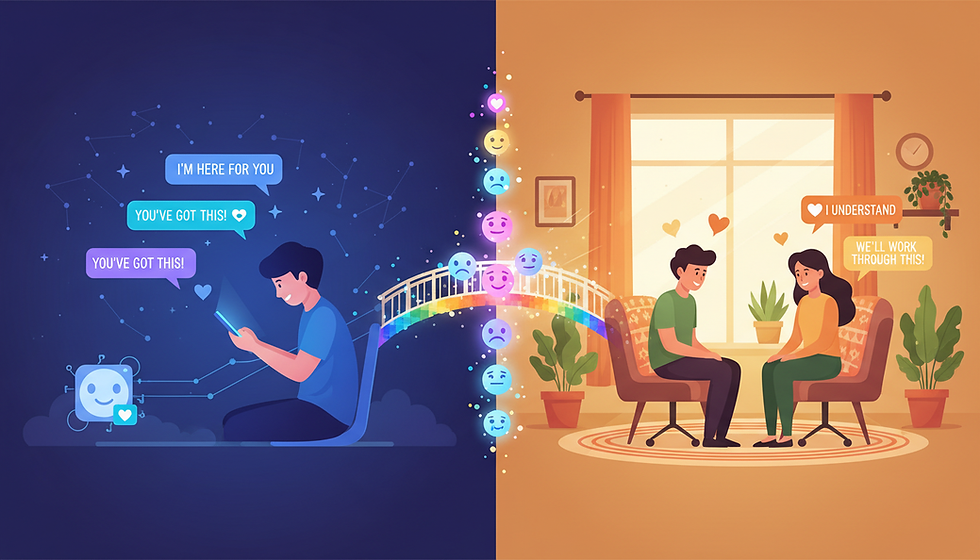
Use AI as a bridge, not a destination - Let it help you identify what you need, then seek appropriate human support
Notice patterns - If you're only comfortable sharing with AI, that itself might be worth exploring with a human
Set boundaries - Even with AI, emotional processing needs limits and structure
Stay connected - Digital support shouldn't replace human relationships, but supplement them.
The Path Forward
We're writing new rules for emotional well-being in real-time. Each late-night conversation with an AI is a vote for what kind of support we want to normalise.
The teenager who learns coping skills from an AI at 2 AM might feel brave enough to talk to a counsellor at 2 PM. The mother who processes her overwhelm with a chatbot might recognise she needs more human support. The executive who practices with AI might feel ready for that presentation.
Or they might not..... And that's the tension we need to hold.
Technology has always shaped how we connect. From letters to phone calls to texts, each innovation changed not just how we communicate, but what we're willing to share.
Now, as AI becomes our newest confidant, we face a fundamental question:
In our quest for always-available support, are we building better bridges to human connection, or are we learning to be alone together?
The answer likely depends not on the technology itself, but on how consciously we choose to use it.
Because at 3 AM, when Sarah's chest feels tight and tomorrow feels impossible, what matters most isn't whether she talks to silicon or flesh. What matters is that she finds a path from isolation to connection, from panic to peace.
Even if that path begins with typing into a screen.
Anthropic: Claude Opus 4


Comments